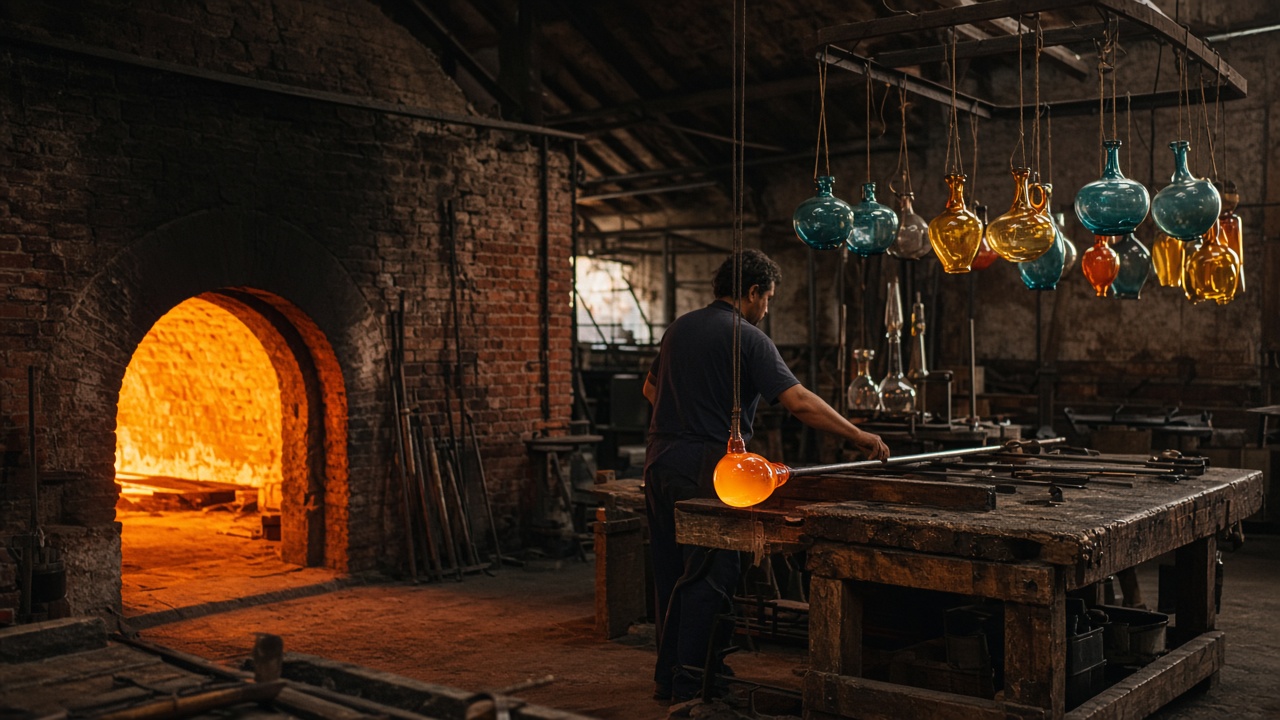
Furnace, heat, workshops
Murano
Murano is a poor read if you treat it as a row of shop windows. Read it from the furnaces, from the heat leaving an open door, and from the canals that keep one workshop off the next.
Heat before talk
Near a furnace you feel heat on your face before you understand what you are looking at. The glass is a bright mass on the end of a pipe, not a cold object already on a shelf.
Stay in the doorway if the workshop lets people pause there. The work has its own tempo and it owes you nothing. Watching is enough.
Taking the glass
A maker takes molten glass on the pipe, turns it, brings it back to the fire, and the shape changes with each turn. It is not always a show trimmed for passersby. Sometimes it is only the day's work.
The noise stays low and steady. The furnace holds. The canal is a few steps away, ready to cool whatever no longer needs that shape.
An island of workshops
Between one furnace and the next there is a canal, a short bridge, a brick wall darkened by smoke. Murano is that alternation, not a single address.
Signs try to pull you indoors. You can stay at the water's edge and still see the smoke, the stacks, and the doors that throw orange light even in daytime.
Not Burano
Burano spends its force on the colour of houses. Murano spends it on fire and brick. Mixing the two islands up because both sit in the lagoon is the fastest way to see neither.
On the way back, as the boat takes the channel toward Venice, your hands stay warm a while if you stood near the furnace. When the stone city shows again, it feels cooler than it did when you left.