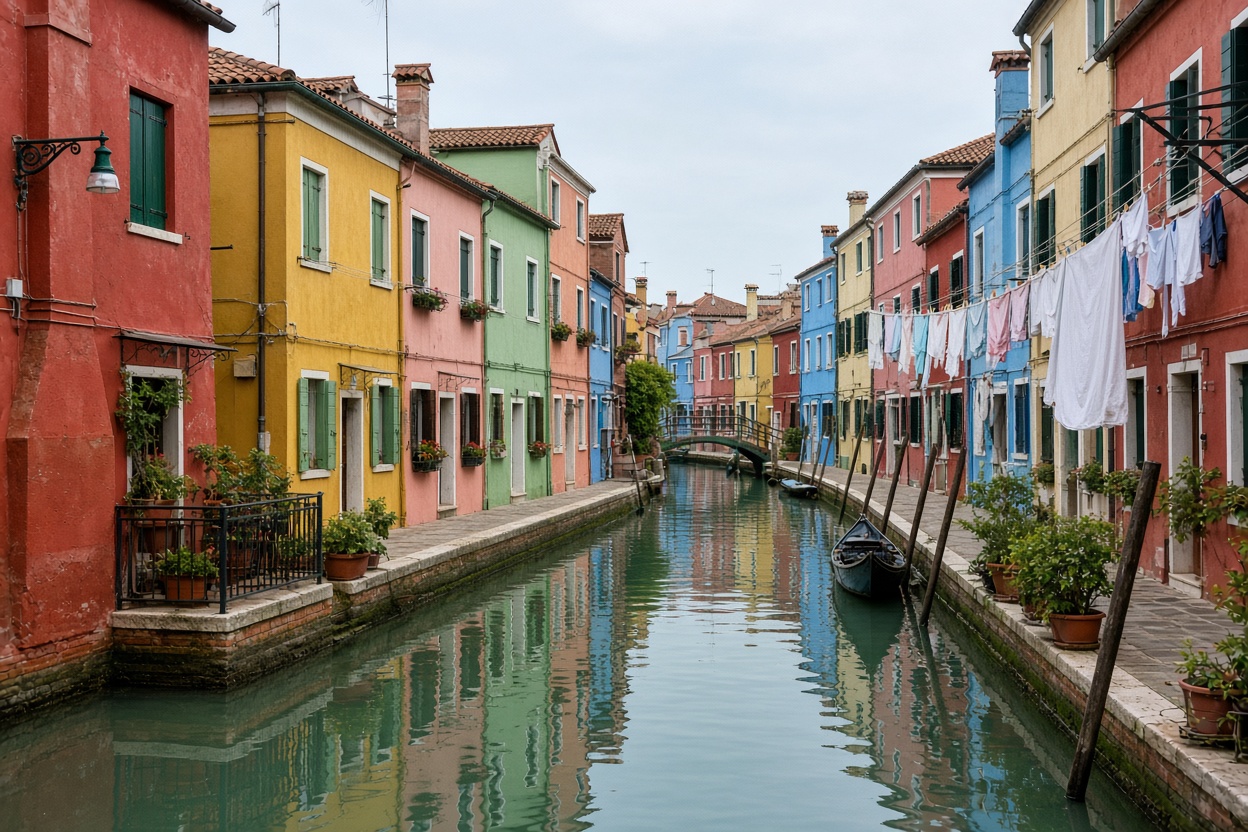
Crossing, colour, lanes
Burano
Burano comes after a stretch of lagoon where the city behind you sinks to a line. The island meets you with painted houses and with canals that have none of the Grand Canal's width.
The crossing
The ride out is already the visit. Side wind, poles in the water, fishing boats at rest. There is little to read and a great deal to watch.
When the leaning tower separates from the roofline, you are close. The pontoon is short. You step off and the engine noise dies quickly.
Paint on plaster
The colour is paint on plaster, put on again when it fades, not a filter. Red against green, blue against yellow, and between them a lane in shade.
You do not need the house people photograph most. Walk, and the colour changes at each turn. A dark door, a window with a geranium, a wall that was pink and is now nearly white.
Canals at house scale
The canals here are domestic. One tied boat takes half the width. The bridge is a low arch, and the far side is already another colour.
You hear laundry and, at some hours, a radio from a kitchen. It is not the silence of a postcard. People live on the island, even when visitors fill the main lane.
Back to the pontoon
The right walk returns you to the water without chasing every lane. When the colours start to repeat, you have the rhythm of the place.
The ride back is clearer than the ride out, because you now know which way Venice lies. Sit outside if there is room, and watch Burano shrink.